Post Global Village
Sala Semiottagonale, MIP · 12—14.06.2025. Projects by ISIA students on movement and migration.
CTRL+ALT+CANC
Accessories for people on the move. Each project is named after a keyboard shortcut: copy, cut, save, repeat. What you take with you, what you leave behind, what you rebuild.

01 / 12
CTRL+C
Bag and rug, bag and blanket, container and culturally meaningful textiles. A convertible bag that combines function with a cultural link to migrants’ heritage, to bring a sense of comfort and familiarity during relocation.

02 / 12
CTRL+X
A dual object that lets you shut out the outside world and its chaos, to reflect, meditate, rest or take a moment for yourself when worn as a hood. Used as a bag, it holds what you need for your own personal journey.

03 / 12
CTRL+A
In the delicate context of displacement and loss, CTRL+A starts from a utopia: carrying the impossible with you. On a symbolic level you can carry things that cannot be carried, but reality forces you to choose what goes into the net and what doesn’t, what you can take and what you have to let go.

04 / 12
CTRL+P
The accessory tells the experiences and emotions lived while on the move, eases conversations and moments with others and with ourselves, and becomes the analogue version of a personal story.

05 / 12
CTRL+R
"Ctrl + R" celebrates the experiences of the migrants who will wear it, tracing their path and experience on a wearable map. The ruana as a symbol of hope and identity, a surface where one’s story comes to life and wraps around us.

06 / 12
CTRL+D
Flavours and smells in the kitchen play an extraordinary role in shaping our memories and connect people to their cultural roots. Every smell brings back emotions, memories and a deep connection with our identity. A tangible way to preserve one’s own story and culinary tradition.

07 / 12
CTRL+ESC
Through collections, adults and children learn about new objects and ideas, interact, swap, share and tell their own story. An accessory that highlights the social side of collecting and builds interpersonal skills and self-esteem, inviting the wearer to invent new collections.

08 / 12
CTRL+F
Leaving home, leaving behind objects full of memories, emotions, sounds: how do you tell who you are and where you come from when you have nothing left to do it with? An interactive tool tries to overcome the silence of absence, using symbols, icons and small objects.

09 / 12
CTRL+S
So as not to get lost in the chaos of the world, to recognise the bonds worth holding on to, including the one with yourself. The object helps keep friends, family and precious memories alive. But if what you carry gets too heavy, it can suffocate you.

10 / 12
CTRL+W
Safety and emotional protection: the den/little house is a safe haven for children, where they can play with their imagination and feel protected from stressful or anxious situations. The accessory works as a bridge to those experiences, bringing back, if only for a moment, familiar and pleasant emotions.

11 / 12
CTRL+Y
An archive of smells that, like a photo album or a playlist, brings back the olfactory baggage of our experiences and our life. Moments, situations, places. People and objects evoked through images and words, to reveal the invisible link between our sense of smell, memories and emotions.
12 / 12
CTRL+V
A shared, cooperative bag designed to be carried by two people at once, making it easier to carry things. It promotes social design, encouraging reflection on what carrying objects means and on the value of sharing experiences on the move.
Stools
Seats that tell stories of migration: myths, codes, luggage, connections.
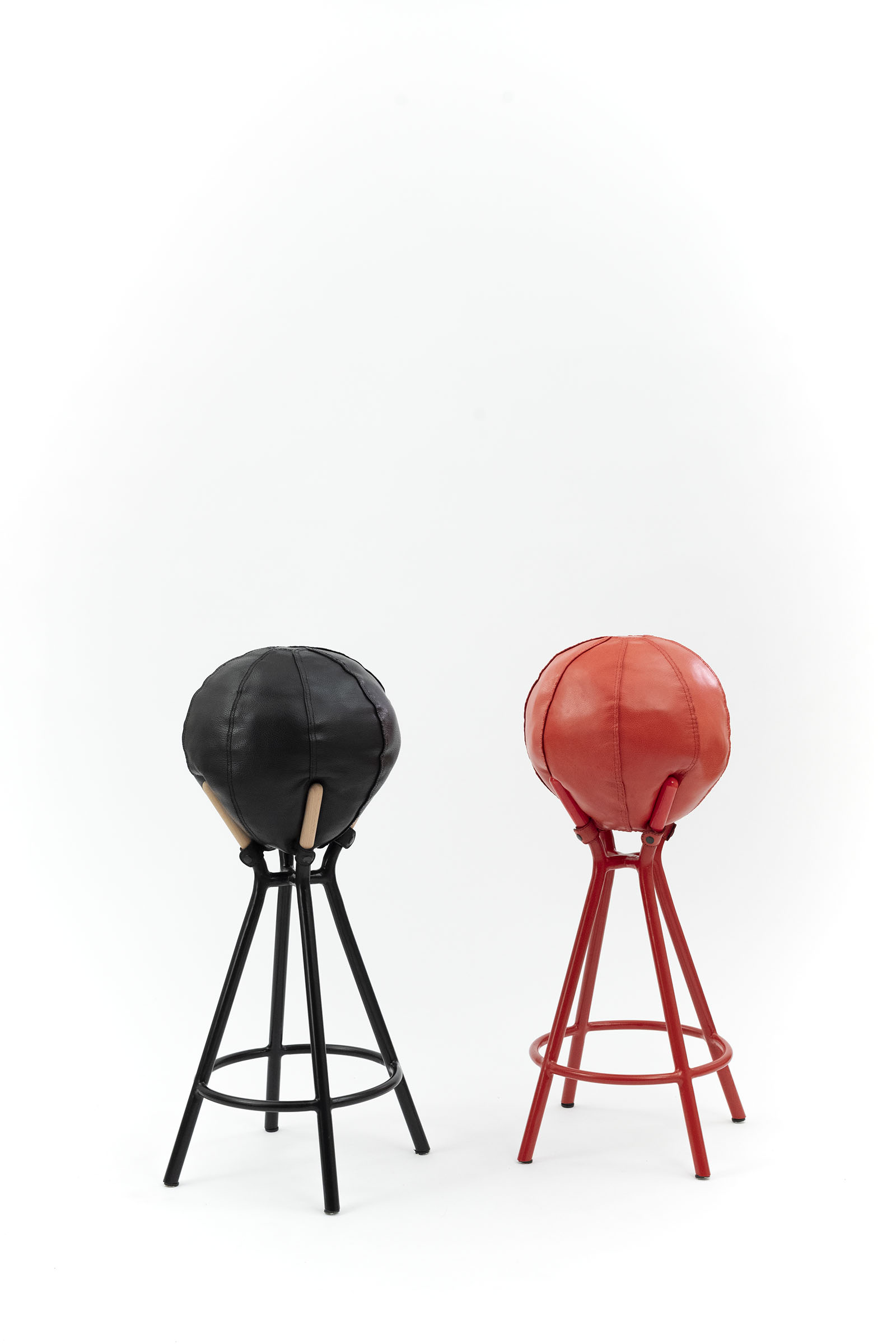
01 / 13
FAKEN
In design, a myth refers to an object that does not keep the promise it makes visually or on paper: something that looks extremely comfortable can turn out uncomfortable in everyday use. In this project the roles are reversed: an apparently dysfunctional look hides real, comfortable use. In the specific context of climate migration, this idea takes shape in the false information regularly spread by political voices through their channels, which tends to paint in a negative light situations and people who are in fact in extreme need and require support and assistance. The stool has two main elements: a spherical leather cushion – recalling exotic poufs and the globe that stands for the whole of human culture – held up by a four-legged iron frame that lifts and supports it, evoking the care that the planet and everyone living on it deserve.
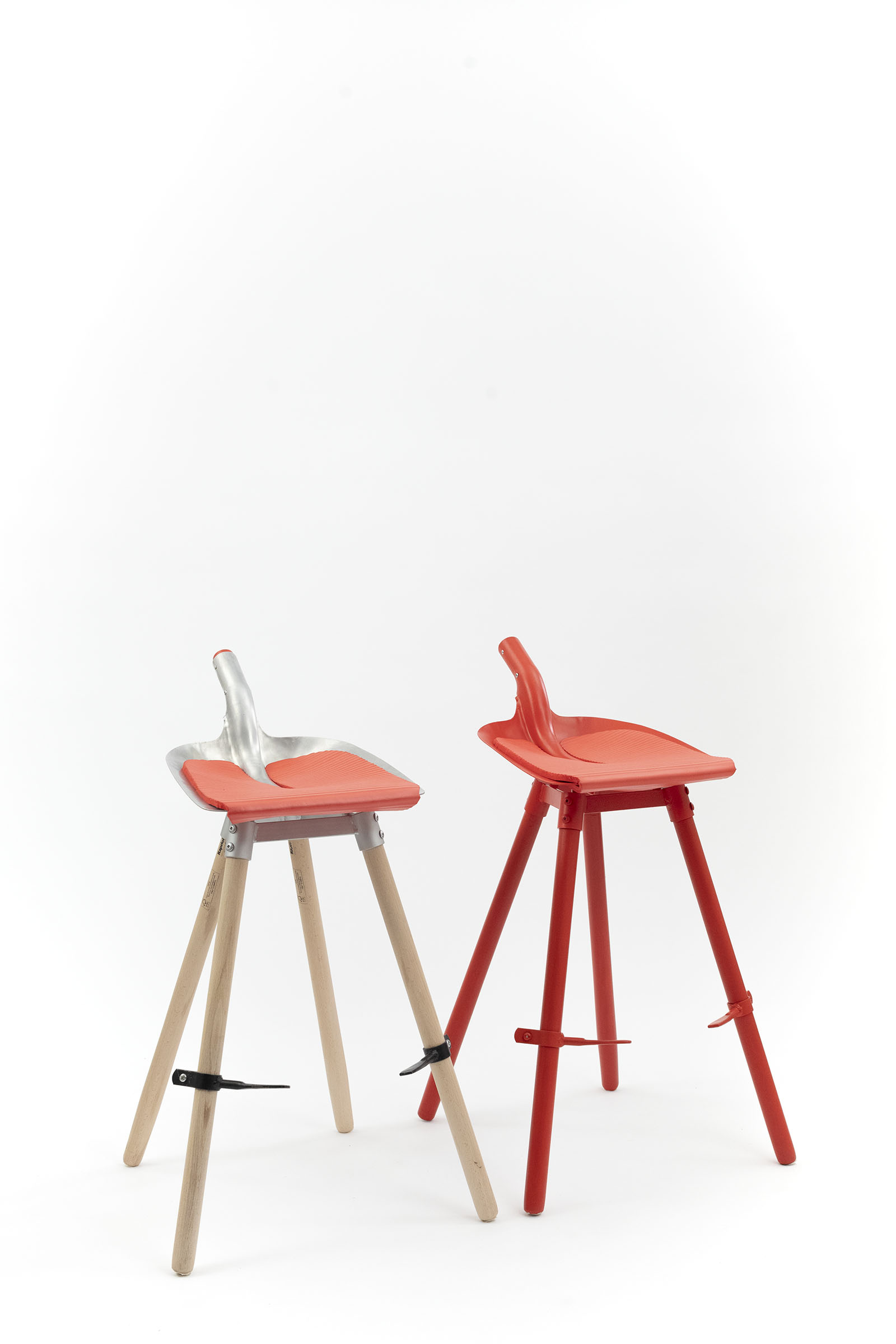
02 / 13
01110000 01100001 01101100 01100001
A ready-made object that, in the tradition of Italian design, evokes a relationship with reality based on effort: that of the daily work routine as much as that of a journey of hope. The seat is a sheet-metal shovel blade, a symbol of the work, strength and resilience needed to face change, and the witness of a function, shovelling snow, that at some latitudes is destined to disappear. The beech legs are hacked shovel handles that, in the stool as in the original, make that specific function possible. The legs are joined to each other and to the seat by a dedicated metal frame. All materials are deliberately left in their natural state, to underline the complete honesty of their original condition.

03 / 13
DRAM
A tangle of woven wool threads forms the heart of the seat and evokes the layered, complex and contradictory emotional baggage of a forced journey. It recalls a memory, a gift, the thought of a loved one, a testimony of roots and history; but also a thread that, along twisting paths, connects. The weaving wraps around a perforated wooden board held up by a structure made of off-the-shelf fencing parts from the hardware store: a galvanised anchor as the main support for the seat, fitted with collars that hold four pine posts. Leaving the materials raw stands for the harsh experience of a journey full of hope, determination, pain and endurance.
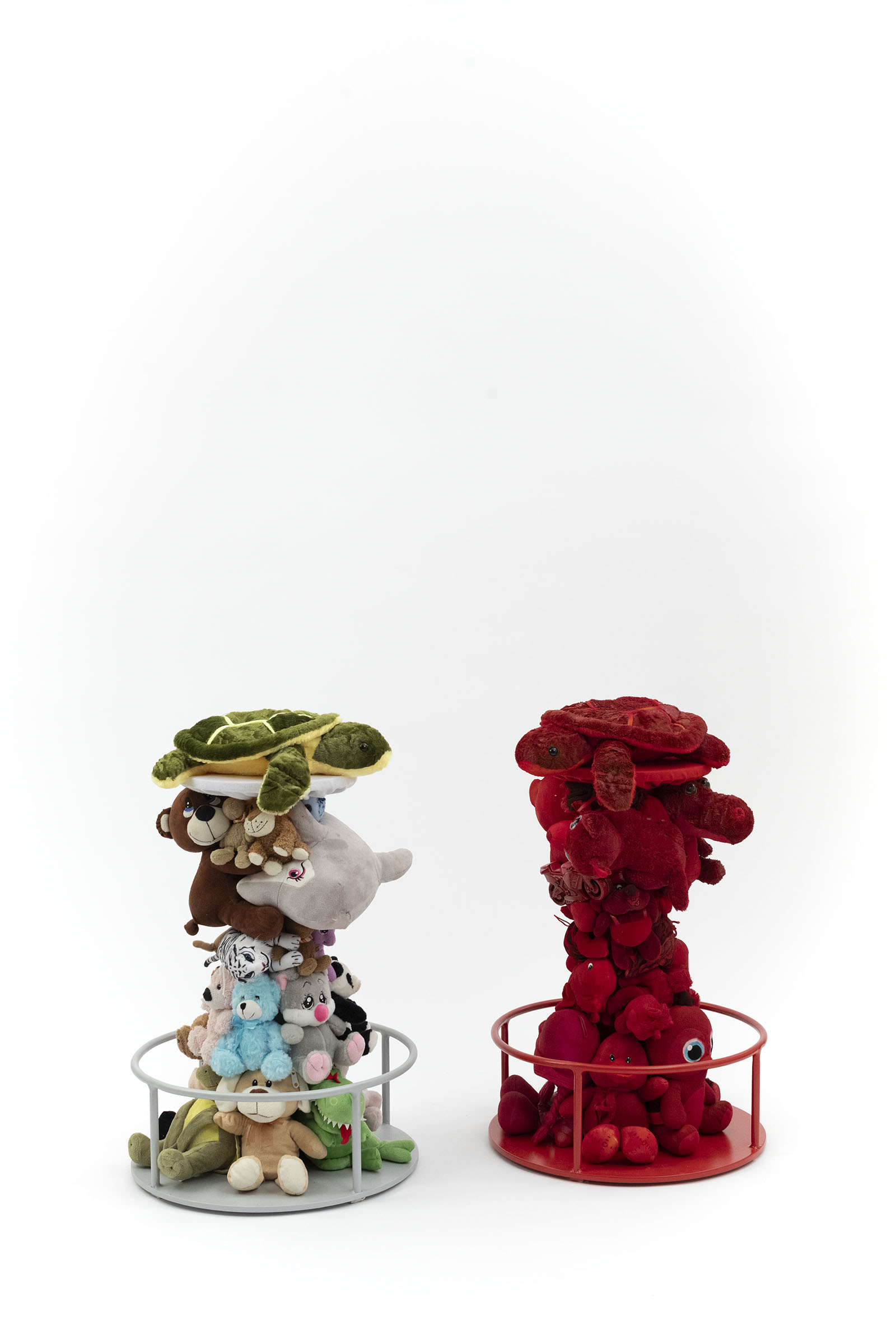
04 / 13
THE GAME
The Game is a single-leg stool with a totem-like structure made of interchangeable modules. The concept comes from the way people reconfigure temporary or makeshift homes with fetishes or totemic objects of all kinds, looking for an idea of “home”. Made with used toys and soft toys, the totem modules recall the traces of childhood that the sea gives back, and using them at home becomes an act of denunciation. The Game is also the name of the Balkan migration route, so called because, like levelling up in a game, a migrant tries to cross dangerous borders dozens of times until they make it. The stool has an iron frame with a base and a central leg that holds the cylindrical modules, topped by a screw-on wooden seat with another soft toy as a cushion.
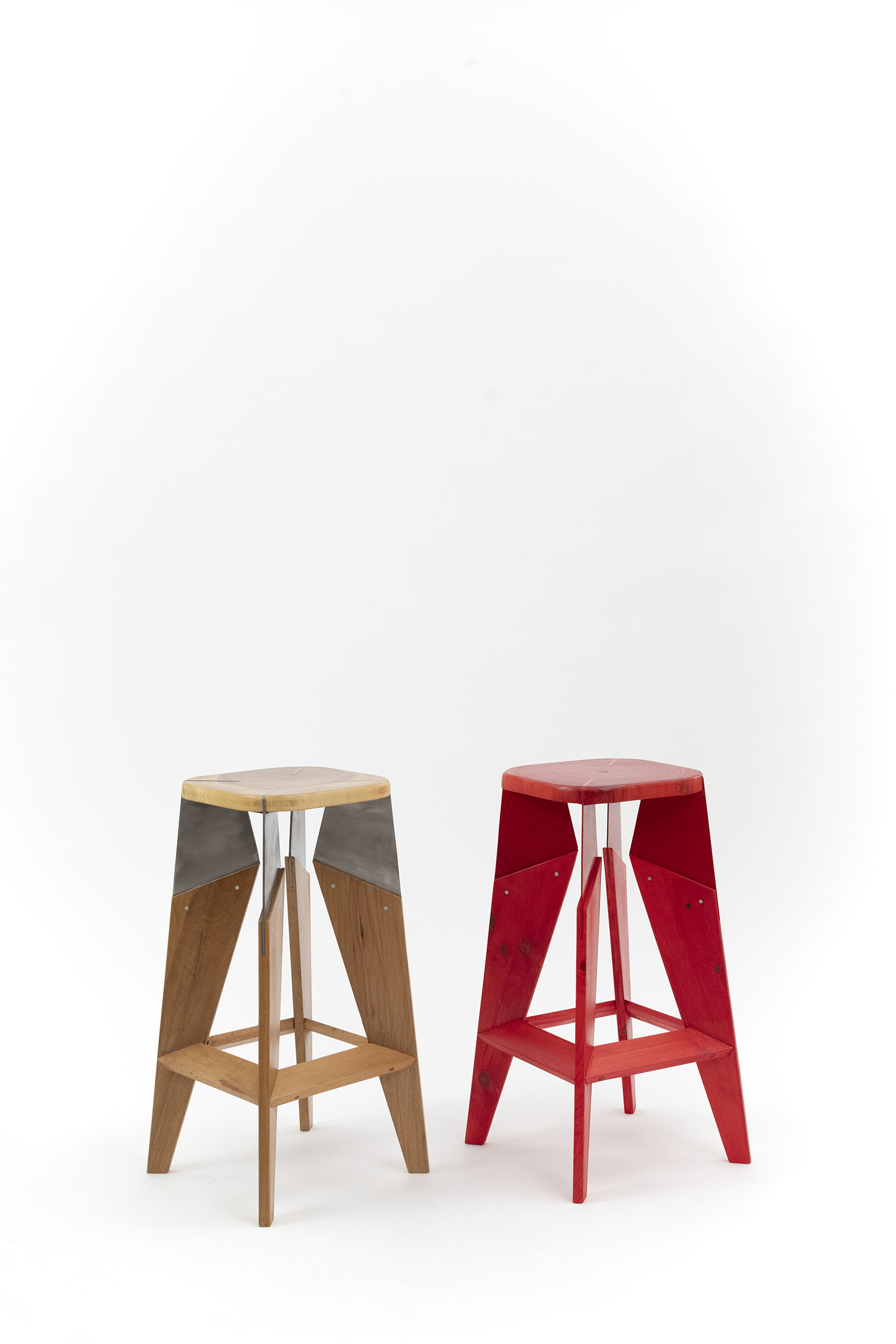
05 / 13
MALWARE
Today’s migration has its roots in colonialism and in exploitation that never stopped. Like a virus, colonial powers entered the host culture, altering and compromising its system. So in Malware – the computing term for software that harms a system – steel blades, a symbol of European power, cut like knives along the concentric grain of the wood, a metaphor for the history and traditions of subjugated peoples. The materials are chosen for strength and durability: the legs are shaped beech boards, joined to the acacia seat by trapezoidal steel brackets that, together with the footrest, resist twisting.
06 / 13
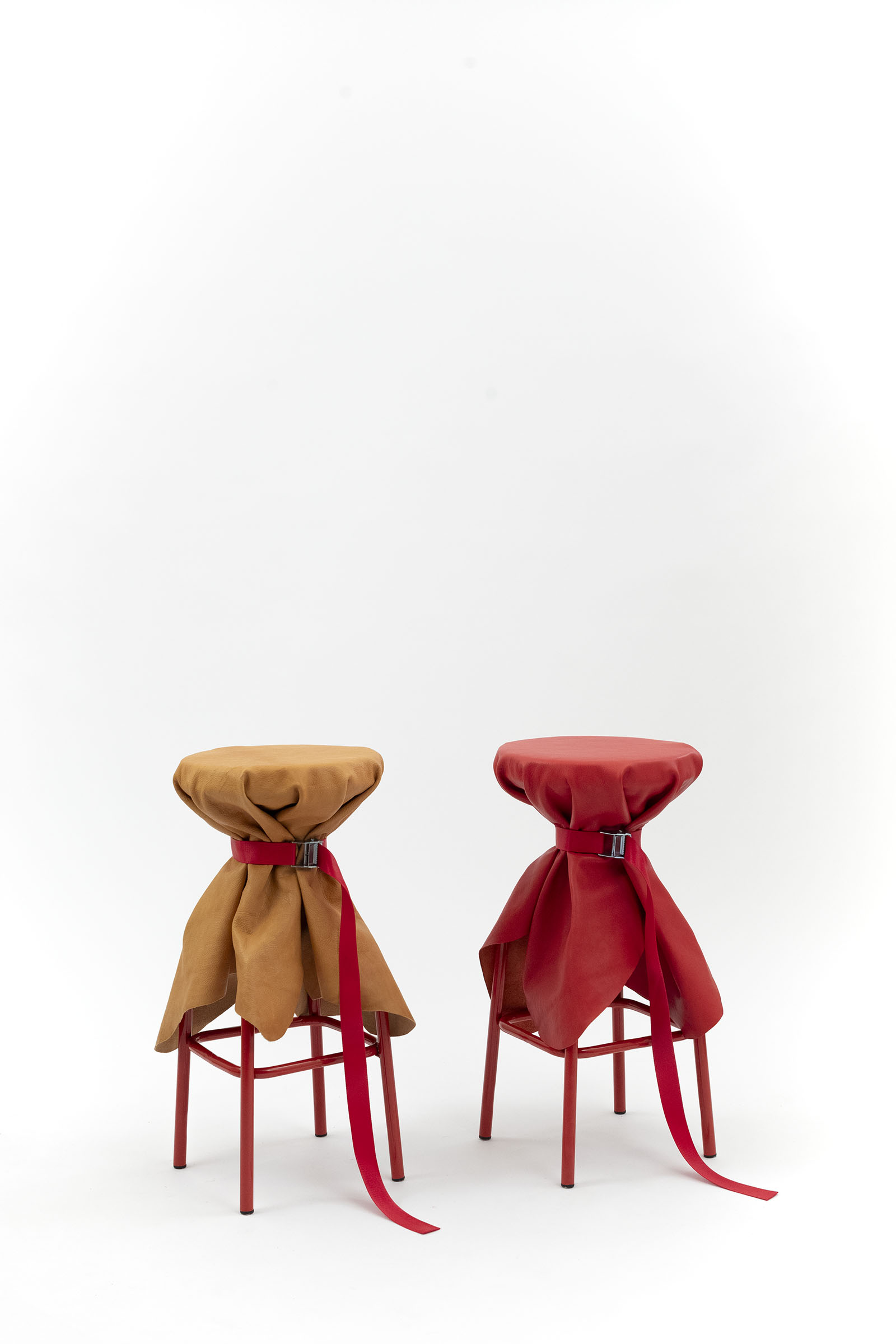
DEBUG
Debug is a stool that gives new life to an existing object. An upcycling project that reuses the metal frame of an old stool and adds a vegetable-tanned leather cover held by tightening straps. Debug is a hybrid, flexible object, durable and immune to perceived obsolescence thanks to the ways it can be transformed. These qualities give it both symbolic and technical value, as it uses existing supply chains instead of starting new ones. The name comes from debugging, the work of fixing errors in software, and is used here as an allegory for solving today’s socio-economic bugs, such as the obsession with growth and the constant push to replace goods. Thanks to Volpi Concerie for the vegetable-tanned leather.
07 / 13
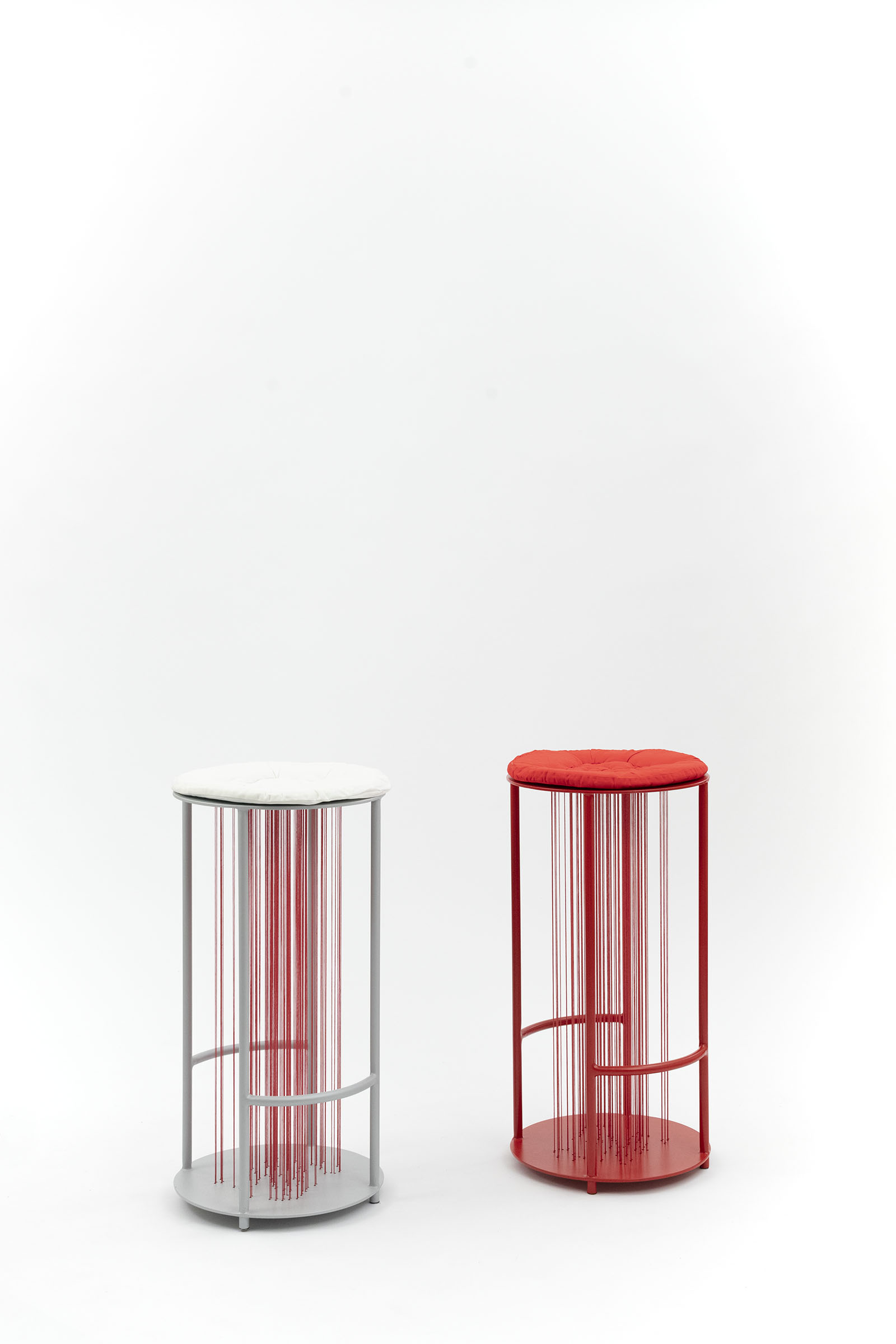
POP
In a scenario full of uncertainty, is it hard to redefine the role of design? What is certain is that an object, through its use and symbolism, must establish a cognitive contract. From these thoughts comes POP (point of presence): a vertical flow of red threads that join the base to the seat, drawing on its surface a dotted map of the main cities along the Mediterranean route. Their strength binds the cushion to the frame. POP is entirely handmade: the frame is iron, the cushion is Aida cloth (a fabric where weft and warp are clearly visible) and the threads are waxed cotton.
08 / 13
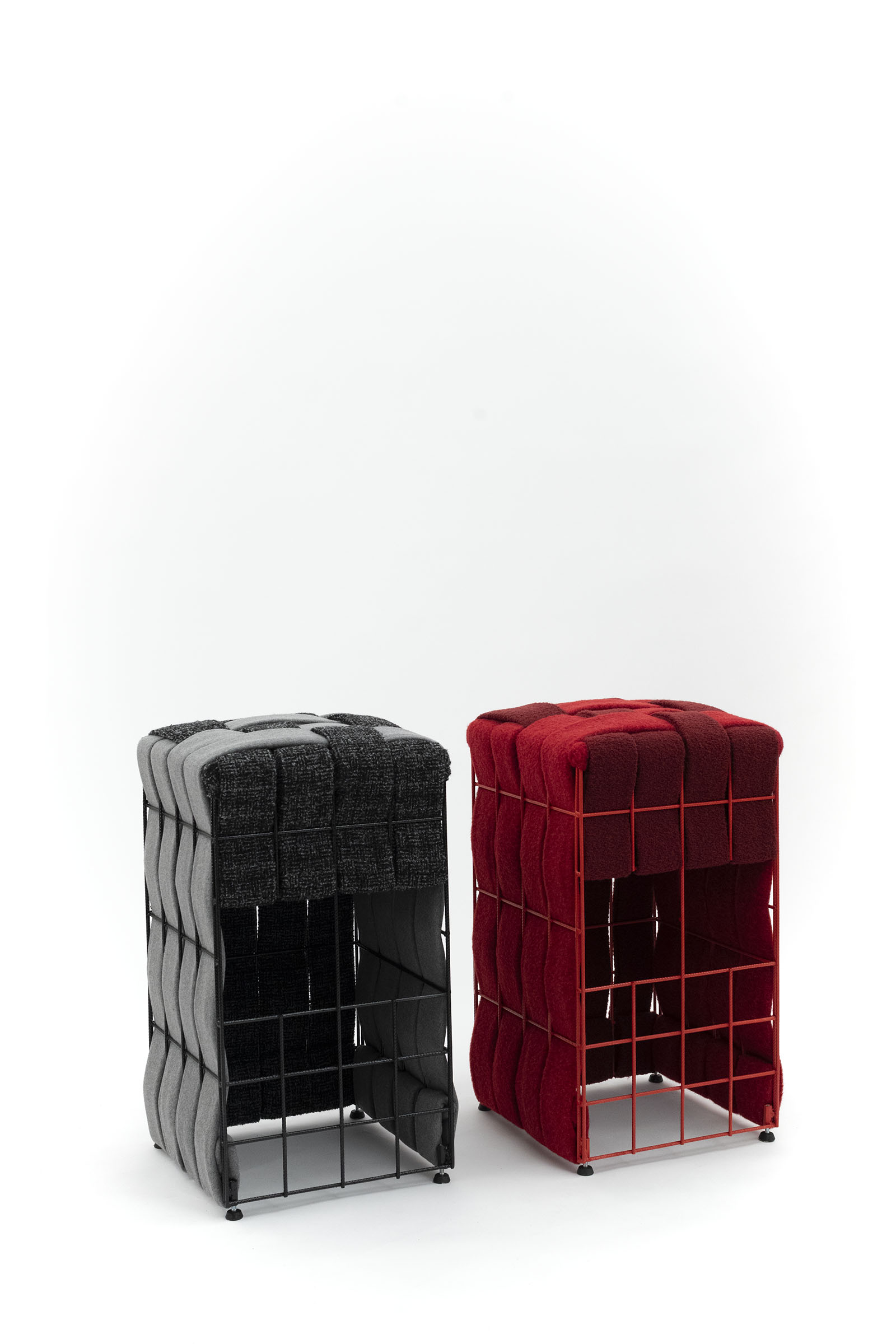
UNDERSCORE
Visible vs invisible: on one side walls, borders, metal mesh; on the other, the condition of climate refugees, migrants, forced travellers not yet recognised in international law. Welded wire mesh physically translates the rigid limits on the freedom to move, forming a grid that is alternately hidden by strips of wool fabric. As in Isgrò’s erasures, where crossing out some words of a text creates a new composition with a new meaning, the mesh appears and disappears between weft and warp. Erasing, concealing, hiding, keeping secret, weaving, plotting: the theme of invisibility bounces from one opposite to another until it becomes encryption. The coded system of weaving has been hacked to create a new, atypical, disorganised, disharmonious pattern. Hidden in these alterations is a message in Morse code adapted to the language of textiles: a few coded letters that spell a universal cry for help. Thanks to Lanificio F.lli Balli for the fabrics.
09 / 13
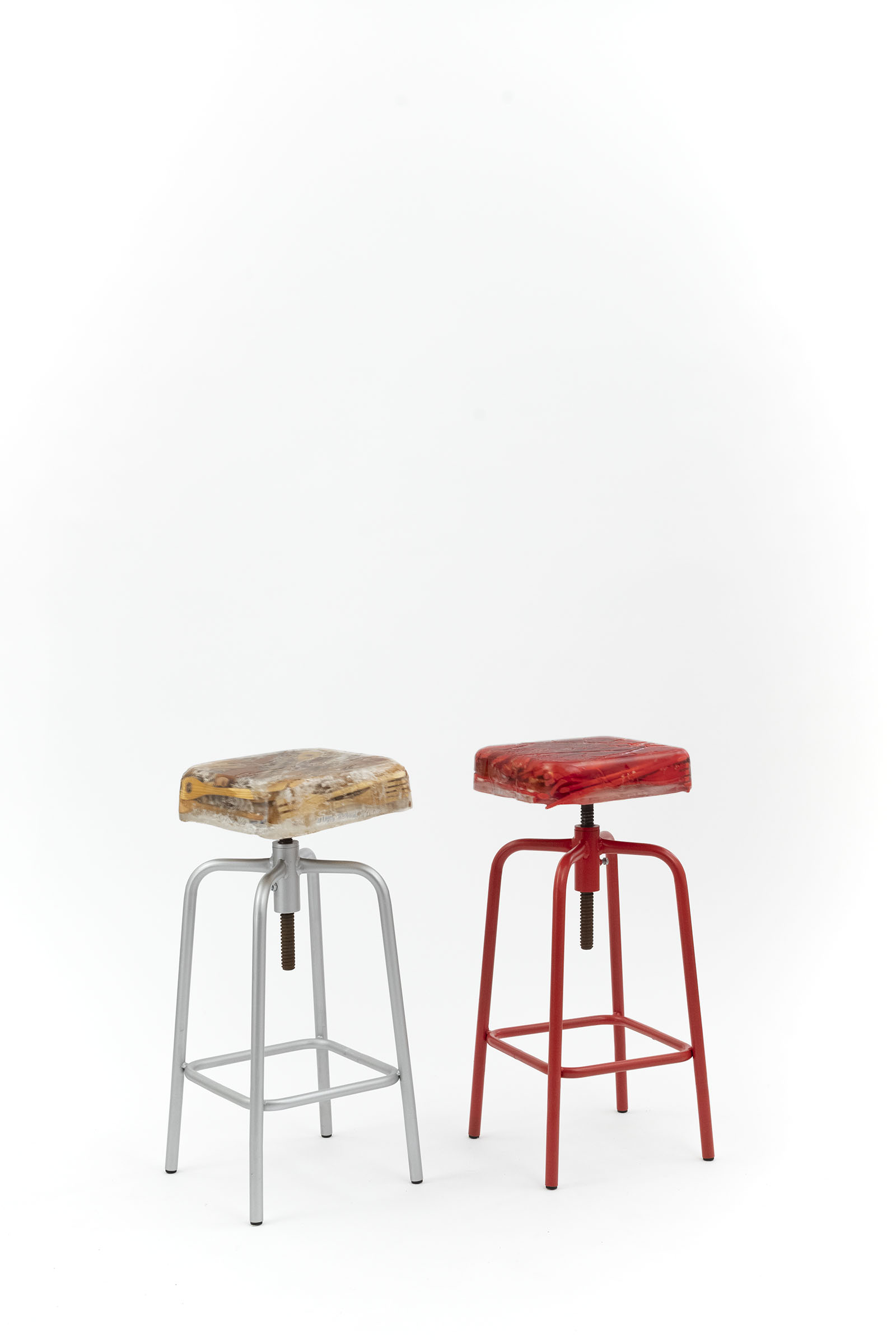
LOADING
Loading has an iron frame and a seat made of wooden ladles set in epoxy resin. The concept grew from a reflection on migration and moving (of masses, cultures and peoples towards other masses, cultures and peoples), choosing the wooden ladle as a symbol: a simple, common tool, as fragile as it is meaningful, so ordinary that nobody takes it with them when forced to leave. And in repetition, the debris of material culture that stays behind. Like Proust’s madeleine, the ladle brings back the time of endless stirring that fascinated innocent eyes: whoever sits on it can travel back in time, reliving smells and flavours and memories of a past that is gone.
10 / 13
PLUG-IN
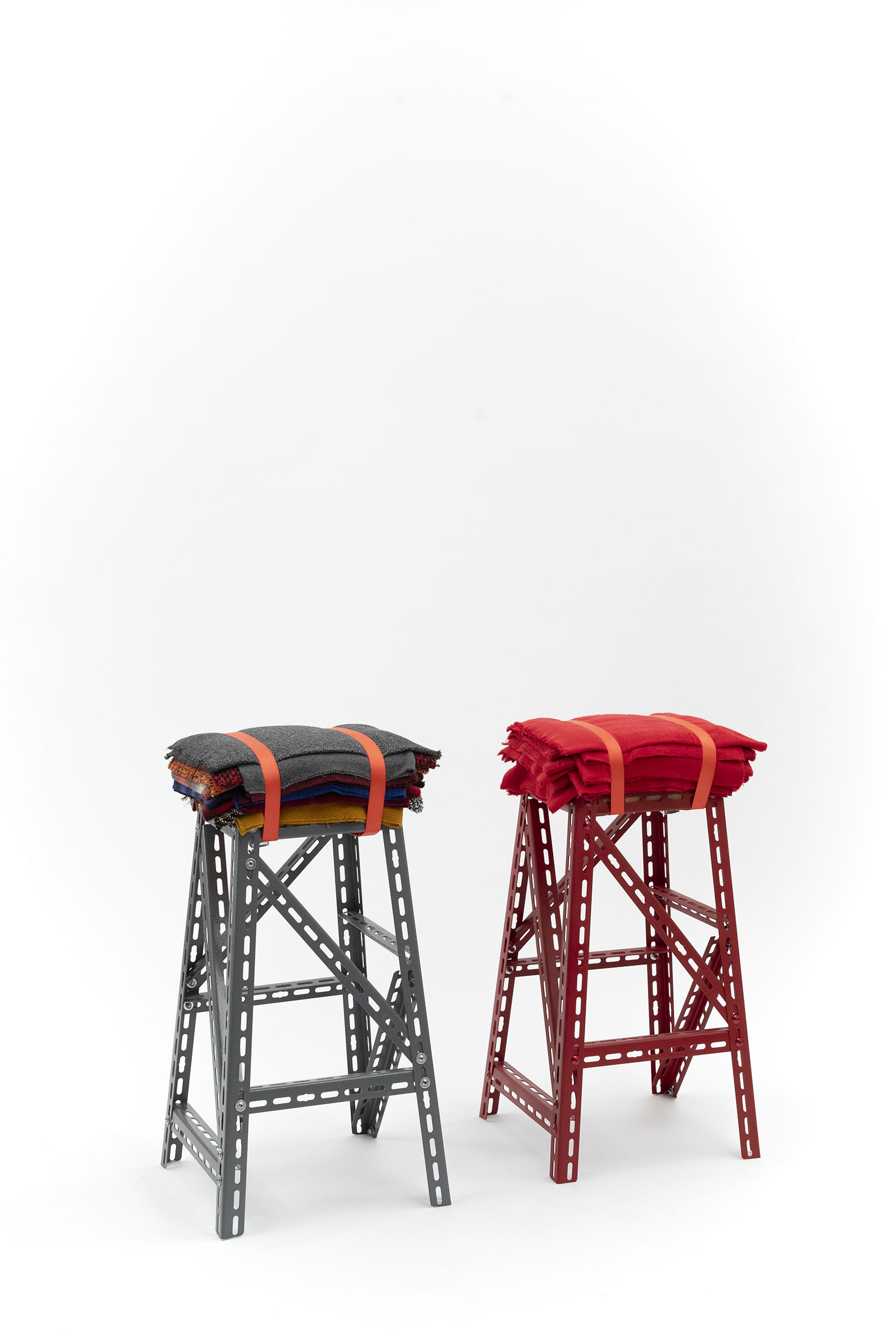
Plug-in is designed to adapt to and fit into any system, combining resistance, welcome and versatility. The frame, made of perforated and bolted metal uprights, stands for the flexible (antifragile) resistance of those who can rethink new ways of living in their territory despite the many crises caused mainly by climate change. The four different footrest heights underline the importance of offering welcome and comfort, ensuring inclusion rather than integration. Layered fabrics, fixed to the stool with two straps, reflect a versatile society ready to face constant change brought by cultural layering, just as users can rearrange the order of the fabrics to suit different situations and settings. Finally, the making process pays attention both to the time of use and to the end of use: every material is left unprocessed, so it can be taken apart and given a second life. Thanks to Lanificio F.lli Balli for the fabrics.
11 / 13
F8
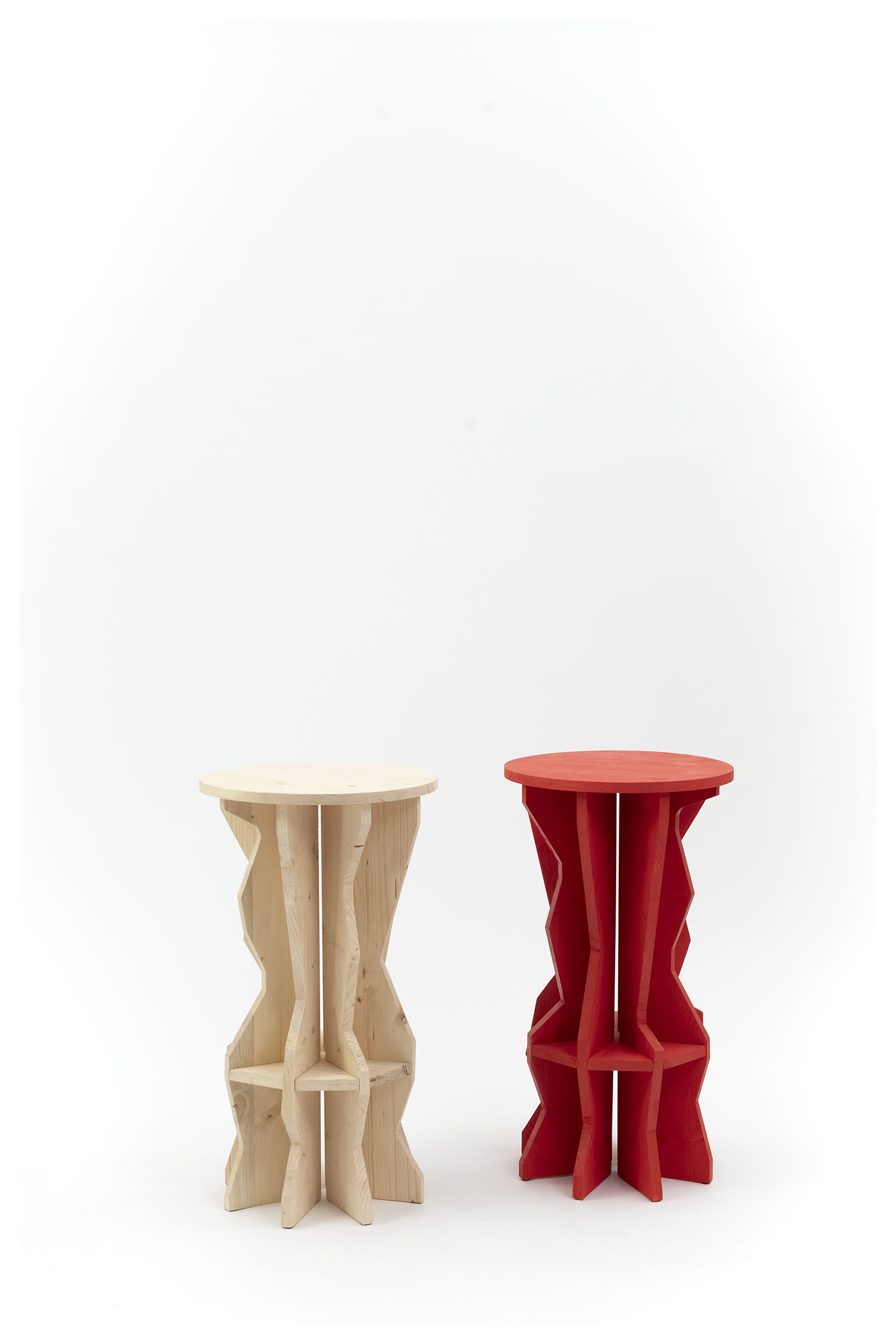
F8 is a stool with eight legs, a symbol of the fragmentation caused by change and uncertainty. Like the F8 key on a keyboard, it offers a set of options: the pieces can be swapped in their radial positions to quickly take on many configurations, for constant customisation. F8 is a visual statement about environmental challenges and the need to adapt, an invitation to reflect on the seriousness of climate change. Just as people can pick up the pieces and rebuild, F8 is a tangible symbol of an antifragile response to adversity, turned into an opportunity for growth and positive change. Like that half-magic key that gives users another way to handle problems or reach special functions.
12 / 13
PLAYLIST
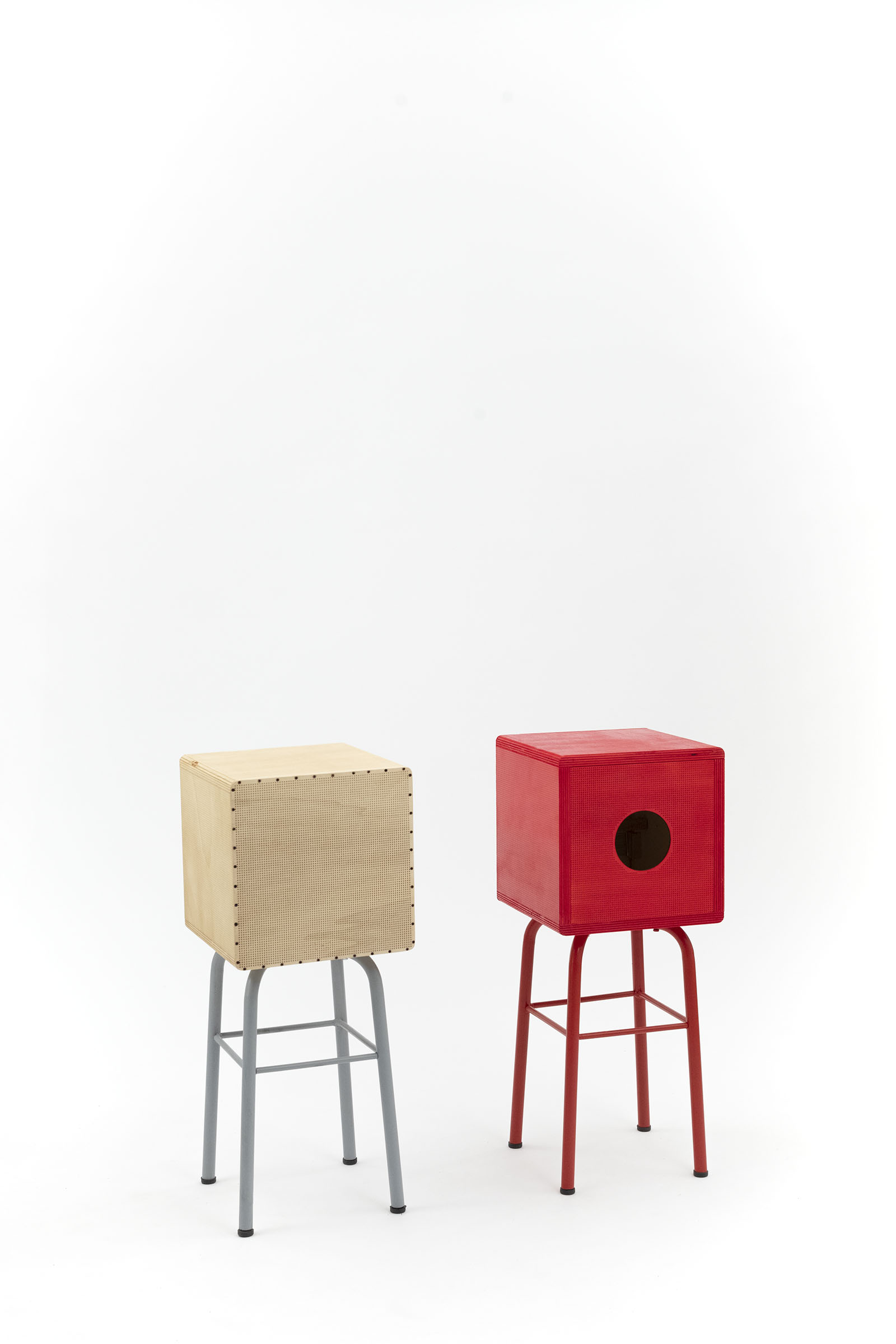
The Playlist stool links the classic seat with a musical instrument: the cajón. The cajón dates back to the Spanish colonisation of the Americas, when enslaved Africans were taken to Peru to work in plantations and mines, and was born as an alternative to drums, using wooden crates, boxes or baskets. The name Playlist, starting from songs, denounces the numbers (another list) of the victims of the Mediterranean route through crosses engraved on the stool itself. Exactly 28,878, as many as the people missing at sea from 2014 to 2023. A list on repeat, the tragic sequence of lost lives that keeps growing along a forced route that ended without reaching a destination.
13 / 13
TEXO
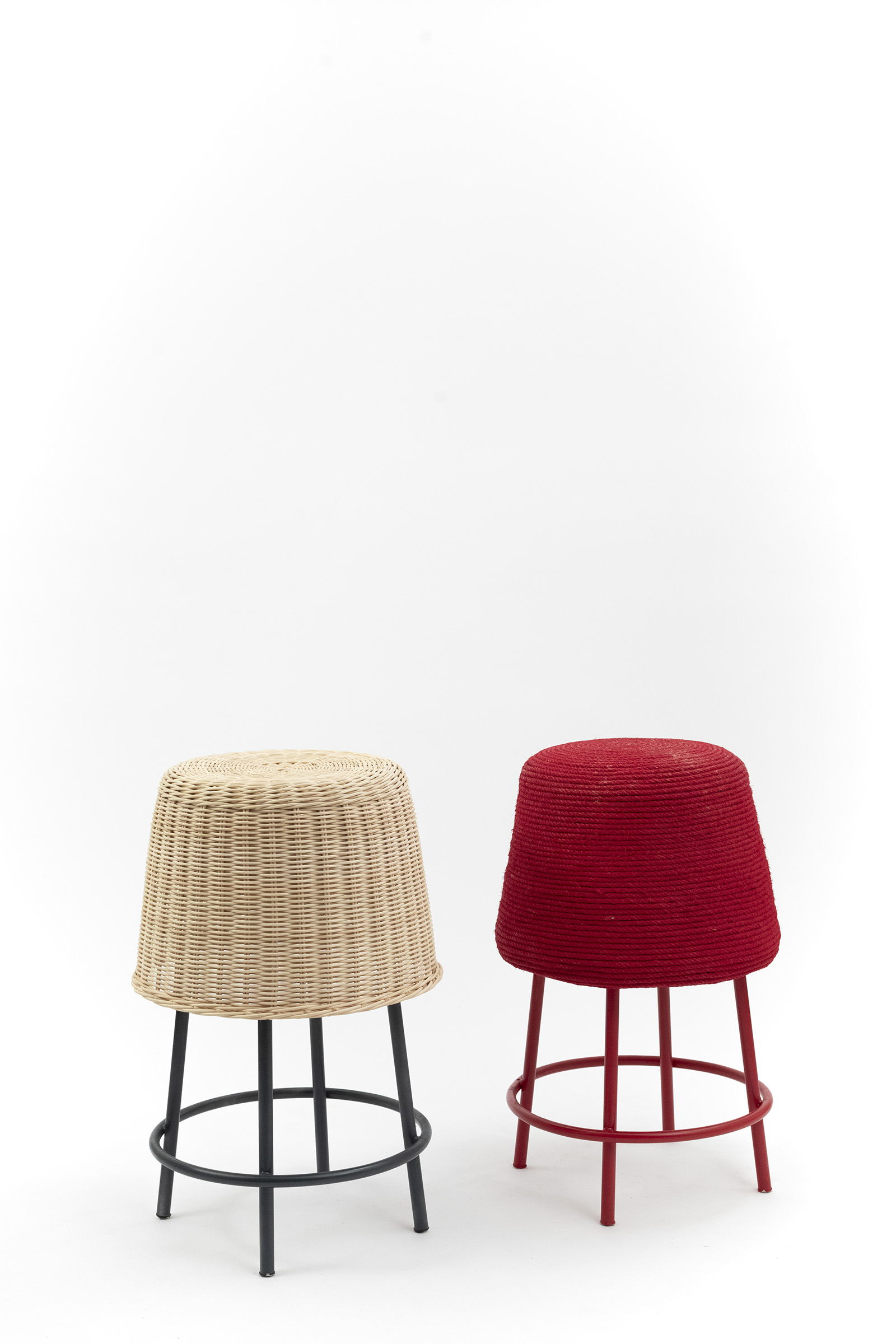
Texo evokes the harshness of the journey through a rough, honest materiality, together with the contradictory conditions and emotions faced by anyone who sets out on a migration route. By emphasising its seat, an upturned basket, Texo also tells of luggage, often non-existent or carried with effort, in conditions that leave no room for a wheeled suitcase as on a holiday. Through materials, colours and impressions, this stool is inspired by and dedicated to the journey made out of necessity, towards a new life, that does not always reach other shores.